Breaking Through Rock Art Recording: 3D laser scanning of megalithic rock art
Durham University, 2005. https://doi.org/10.5284/1000248. How to cite using this DOI
Data copyright © Durham University unless otherwise stated
This work is licensed under the ADS Terms of Use and Access.

Primary contact
Dr
Margarita
Diaz-Andreu
Department of Archaeology
Durham University
South Road
Durham
DH1 3LE
England
Tel: 0191 3341127
Fax: 0191 3341101
Resource identifiers
- ADS Collection: 430
- DOI:https://doi.org/10.5284/1000248
- How to cite using this DOI


Introduction
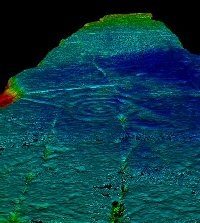
This project tests the novel technique of 3D laser scanning for the recording of prehistoric rock carvings. The main objectives is to assess the reliability, accuracy and precision of this technique for recording purposes and to evaluate its capacity to discover new carved motifs invisible to the naked eye. In addition the project assessed the potential of the technology for monitoring rock surface decay, and examined its value as a visualisation and presentation tool. The study was undertaken at two stone circles in Cumbria which exhibit megalithic art: Castlerigg and Long Meg and Her Daughters (pictured right), on the Copt Howe panel also in Cumbria, and the Horseshoe Rock in Northumberland.
The project website is available from the following URL: http://www.dur.ac.uk/prehistoric.art/
Further information on the project can be found in the following publications:
- Barnett, T., A. Chalmers, M. Díaz-Andreu, G. Ellis, P. Longhurst, K. Sharpe & I. Trinks (2005) '3D Laser Scanning For Recording and Monitoring Rock Art Erosion', International Newsletter on Rock Art (INORA) 41: 25-29 http://www.bradshawfoundation.com/inora/newsletter_index.html and http://eprints.dur.ac.uk/archive/00000124/
- Díaz-Andreu, M., C. Brooke, M. Rainsbury & N. Rosser (2006) 'The spiral that vanished: the application of non-contact recording techniques to an elusive rock art motif at Castlerigg stone circle in Cumbria', Journal of Archaeological Science. http://www.dur.ac.uk/m.diaz-andreu/articles/2006_JAS_spiral_stone.pdf
- Díaz-Andreu, M., R. Hobbs, N. Rosser, K. Sharpe & I. Trinks (2005) 'Long Meg: Rock Art Recording Using 3D Laser Scanning', Past 50: 2-6. http://www.ucl.ac.uk/prehistoric/past/past50.html#LASERSCANNING and http://eprints.dur.ac.uk/archive/00000144/
- Trinks, I., M. Díaz-Andreu, R. Hobbs & K. Sharpe (2005) 'Digital rock art recording: visualising petroglyphs using 3D laser scanner data', Rock Art Research 22 (2): 131-9. http://www.dur.ac.uk/m.diaz-andreu/articles/2005_RAR_Trinks_et_al.pdf
 This archive was one of the case studies for the English Heritage funded Big Data Project. To find out more about the project go to the Big Data Project Web Pages