Medieval Monastic Cemeteries of Britain (1050-1600): a digital resource and database of excavated samples
Roberta Gilchrist, Barney Sloane, 2005. https://doi.org/10.5284/1000273. How to cite using this DOI
Data copyright © Prof Roberta Gilchrist, Barney Sloane unless otherwise stated
This work is licensed under the ADS Terms of Use and Access.


Primary contact
Barney
Sloane
University of Reading
Kemble Drive
Swindon
SN2 2GZ
England
Tel: 0160 8811846
Resource identifiers
- ADS Collection: 454
- DOI:https://doi.org/10.5284/1000273
- How to cite using this DOI
Introduction
In 1999 the Arts and Humanities Research Board (now Council) awarded a major research grant to Prof Roberta Gilchrist at the University of Reading to direct a national survey of medieval burial practice through the detailed study of excavated cemetery samples, primarily from religious houses. This detailed survey was undertaken by Research Fellow Barney Sloane, and covered the period c 1050 - 1600 CE. All forms of religious house were considered, and some comparanda from emergency cemeteries, parochial cemeteries, cathedral cemeteries and Jewish cemeteries were also gathered. Where the data permitted, digital plans of each cemetery were compiled, and a relational database constructed to capture all variable attributes of grave cut, skeletal demography, burial container, and artefacts associated with the burial.
The digital resource presented here covers over 8000 excavated medieval burials from 70 separate cemetery excavations in England, Wales and Scotland. This data is presented at a number of different levels:
- First, there is a summary sheet for each cemetery included. This provides location, references and a brief overview of the entire assemblage. The full references can be found in the digital bibliography provided.
- Second, there are simple downloadable Excel files containing basic data for each identified inhumation described or catalogued in the relevant reports. These have been used where no detailed cemetery plan evidence was readily available during the research period, or where it could not be linked to published plans at the level of individual inhumations through lack of specific numeric cross-references.
- Third, and most detailed, where full plan data was available and could be cross-referenced to attribute data, the cemetery plans have been digitised using AutoCAD, and a relational database of attributes created (originally on an Oracle platform). These are suitable for downloading and conversion into operational GIS environments and can thus be queried spatially.
The files described above can be accessed either by site name or location in the downloads section of this archive. In addition, the full burial database has also been made available to search online and provides access to the downloads via the Site Name link.
Metadata for the attribute fields are provided in the Overview page and excavators of new medieval cemeteries are warmly invited either to place their own data with ADS for inclusion in this expanding research resource (recommended), or to submit the relevant data or reports to the author (at barney.sloane@english-heritage.org.uk) for future inclusion (this may result in some delay).
Note that since the resource is based on the cemetery for each religious house, and not directly on the local authority or museum 'site-code' or other planning-related identifier, the decision was made to use new 'cemetery codes'. In this way, future investigations of new areas of cemeteries already partly covered can be integrated with existing data.
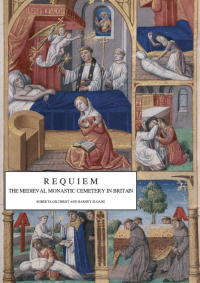
The digital resource is designed to be used in conjunction with the hard-copy publication based on the survey:
Gilchrist, Roberta and Sloane, Barney 2005, Requiem: the medieval monastic cemetery in Britain. Museum of London Archaeology Service, ISBN 1-901992-59-4.
To purchase this book visit the MoLAS website.
Further information on the project can also be found in an feature in British Archaeology entitled Requiem For a Lost Age.