Parts and Wholes: object categorisation and fragmentation in prehistoric context
J C Chapman, Bisserka Gaydarska, 2011. https://doi.org/10.5284/1000419. How to cite using this DOI
Data copyright © Emeritus Prof J C Chapman, Dr Bisserka Gaydarska unless otherwise stated
This work is licensed under the ADS Terms of Use and Access.


Primary contact
Emeritus Prof
J C
Chapman
Reader in Archaeology
Department of Archaeology
Durham University
South Road
Durham
DH1 3LE
England
Tel: 0191 378 0641
Resource identifiers
- ADS Collection: 462
- DOI:https://doi.org/10.5284/1000419
- How to cite using this DOI
Introduction
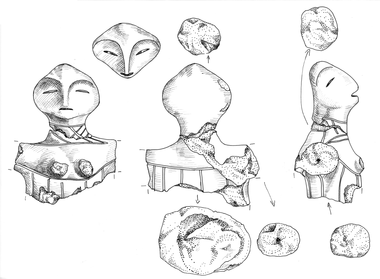
Female figurine from Tell Dolnoslav
© Archaeological Museum Plovdiv.
The 'Parts and Wholes' project is concerned with the relationship between complete objects and their fragments. The primary premise of the project can be concisely stated: deliberate object fragmentation was commonplace in the past, with widespread re-use of the ensuing fragments in an extended life 'after the break'. It has been the contention of much recent research that deliberate fragmentation is a fundamental feature of not only later Balkan prehistory but also of communities living in many other times/places. The evidence for deliberate fragmentation is increasing each year, both at the level of inter-site data and intra-site data, such that the social practice can no longer be ignored by anyone seriously interested in material culture.