Town and Country in Roman Essex: Settlement Hierarchies in Roman Essex
Archaeology South-East, English Heritage, University College London, 2011. https://doi.org/10.5284/1011886. How to cite using this DOI
Data copyright © Archaeology South-East unless otherwise stated
This work is licensed under the ADS Terms of Use and Access.


Primary contact
Dr
Dominic
Perring
Director
Archaeology South-East
Units 1 and 2
2 Chapel Place
Portslade
BN41 1DR
UK
Resource identifiers
- ADS Collection: 1076
- DOI:https://doi.org/10.5284/1011886
- How to cite using this DOI
Introduction
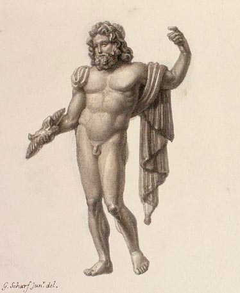
Drawing of a small bronze figure of Jupiter
found at Colchester. Drawing from the
Society of Antiquaries Catalogue
The Town and Country in Roman Essex project is a large scale regional study based on correspondence analysis of finds assemblages, including coins, pottery, registered finds, animal bone and vessel glass. By comparing quantified finds datasets from different individual sites and whole classes of site, such as urban centres, small towns, villas, nucleated settlements and lower-status rural sites, the project looks at how consumption is influenced by factors such as the influence of command and or/market economies, cultural identity and site status/function. The project also attempted to assess the viability of conducting such research and report on any relevant issues, relating to the recording, archiving and publication of finds assemblages.
Data was primarily gathered from existing published or archive sources and was collected from sites in Essex, south-east Cambridgeshire and London dating to the period c 50BC-AD250. The database includes linked tables on small finds, glass, pottery and coins, as well as for the following aspects of the animal bone assemblages: NSIP, MNI, tooth-wear, MNE and metrics for bone elements.