The Ancient Saar Project: London-Bahrain Archaeological Expedition
Robert Killick, 2007. (updated 2024) https://doi.org/10.5284/1042738. How to cite using this DOI
Data copyright © Dr Robert Killick unless otherwise stated
This work is licensed under a Creative Commons Attribution 4.0 International License.

Primary contact
Dr
Robert
Killick
Resource identifiers
- ADS Collection: 456
- DOI:https://doi.org/10.5284/1042738
- How to cite using this DOI
Introduction
The excavations at Saar, Bahrain, took place between 1990 and 1999. The work was undertaken by the London-Bahrain Archaeological Expedition which was formed specifically for the purpose. The UK academic supporter of the project was the Institute of Archaeology, University College, London. In Bahrain, the Expedition received the patronage of the Amir, the late Shaikh Isa bin Sulman Al-Khalifa. The project was funded mainly by the business community in Bahrain, as well as by the British Academy and other academic funding bodies (for a full list, see Appendix 1 in Saar Volume 3). Archiving of the Saar Imagebank was funded by the Gerald Averay Wainwright Fund. The project directors were Robert Killick, Jane Moon, and Harriet Crawford (for the period 1990-5).
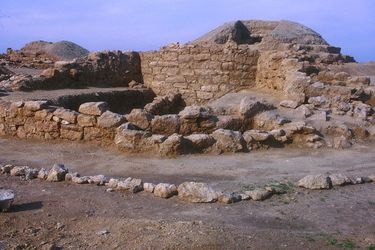
The site of Saar had been previously excavated by a Jordanian expedition (results unpublished) and it was clear from that work that the settlement was inhabited for part of the Early Dilmun period (late third and early second millennia BC) and then abandoned. This corresponds to the period of Bahrain's involvement in Arabian Gulf trade when commodities were shipped through Bahrain, from Oman and the Indus, on their way to the cities of southern Babylonia, and vice versa. A procedure documented, if patchily, in the cuneiform records of the time.
Nearly all previous archaeological work on this period prior to the excavation of Saar has focused on the extensive burial mounds and on isolated temples. The importance of Saar, therefore, resides in the fact that it is the first (and currently only) Early Dilmun settlement to have been investigated in any detail. This importance has been recognised by the Government of Bahrain which has placed the 'Saar Heritage Park' on the Tentative World Heritage List.
The Saar Settlement
The settlement itself is located on a small but prominent eastern outcrop of a limestone ridge which provides about the only natural elevation in the northern part of Bahrain. Immediately west of the settlement, and on the highest part of the ridge, is the Saar burial field, while to the south there are two cemetery complexes of interconnected graves. The settlement is spread over an estimated area of between 15,000 and 23,000 sq m, of which 7,500 sq m was excavated by the end of the project. Saar is a well laid out settlement with a main street running up from the southeastern outskirts; a temple in the centre at the crossroads of the settlement; and two- and three-roomed buildings, constructed in rows (e.g. Block A) with standard room plans and suites of domestic installations. Over 80 buildings, mainly houses, were investigated by the Expedition, as well as a well and a gypsum kiln. All these are described in detail in Saar Report 3. On the basis of pottery comparisons, the duration of the settlement is currently estimated to be about 250 years, from 2100 to 1850 BC approximately.