The Silchester Project: Roman Town Insula IX The Development of an Urban Property c. AD 40-50 - c. AD 250
Amanda Clarke, Michael Fulford, Michael Rains, 2007. https://doi.org/10.5284/1000259. How to cite using this DOI
Data copyright © University of Reading unless otherwise stated
This work is licensed under the ADS Terms of Use and Access.


Primary contact
Prof
Michael
Fulford
Professor of Archaeology
School of Archaeology, Geography and Environmental Science
University of Reading
Whiteknights
PO Box 227
Reading
RG6 6AB
England
Tel: 0118 3788048
Resource identifiers
- ADS Collection: 719
- DOI:https://doi.org/10.5284/1000259
- How to cite using this DOI

Introduction
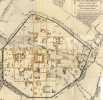
The Roman city of Calleva Atrebatum (Silchester, Hampshire) was subjected to an extensive programme of excavations by the Society of Antiquaries of London between 1890 and 1909. The turn of insula ix came in 1893-4 when one of the most important discoveries was a large town house (House 1) whose north-east/south-west orientation was completely different to that of the Roman street grid aligned on the cardinal points. Apart from the observation that a well which contained a dwarf Roman column incised with a name in ogham script could only 'have been sunk when the portion of the house in which it occurred was in a ruinous condition', no other comment was made about the dating or development of the house.
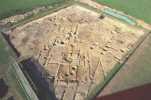
In 1997 a new programme of excavations began on part of insula ix with the aim of exploring the full sequence of occupation from the late Iron Age through to post-Roman abandonment. It rapidly emerged that 'House 1' had a complex history of development with abandonment and demolition in the mid 3rd century AD.
The aim of the article published in Internet Archaeology is to report that development from origins around the mid 1st century AD to demolition about the middle of the 3rd century AD. This archive contains the downloadable data needed to further explore the conclusions reached, including Appendices and Specialist Reports, Database tables, Images, Context Plans and Matrices. The archived database can also be queried online, where information can be found on Contexts, Objects and Finds.
This digital archive was undertaken in conjunction with an electronic publication through the Linking Electronic Archives and Publications (LEAP) project. The corresponding article is 'Silchester Roman Town Insula IX: The Development of an Urban Property c. AD 40-50 - c. AD 250' by Amanda Clarke, Michael Fulford, Mike Rains and Klare Tootell, which can be found in Internet Archaeology 21.