
A Moving House
Collection: The Channel Tunnel Rail Link
The ADS archive also houses many interesting and unusual records. During the excavations for the Channel Tunnel Rail Link, archaeological surveys were carried out in order to preserve important monuments. This exhibit details the monumental undertakings that were carried out to preserve and record the historic environment. In this case, the decision was made to move an historical house 80 metres.
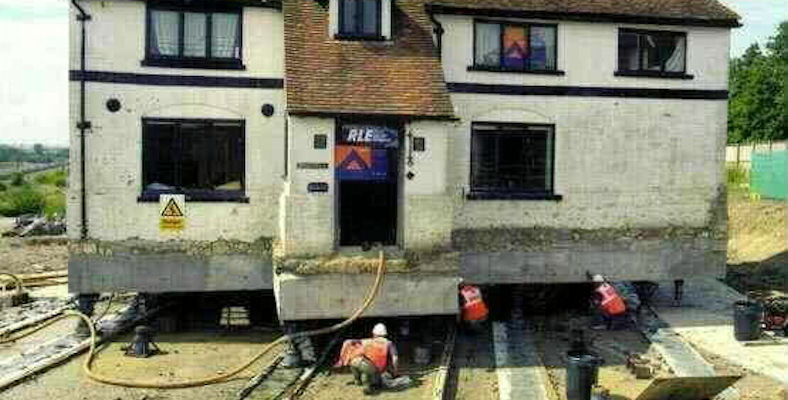
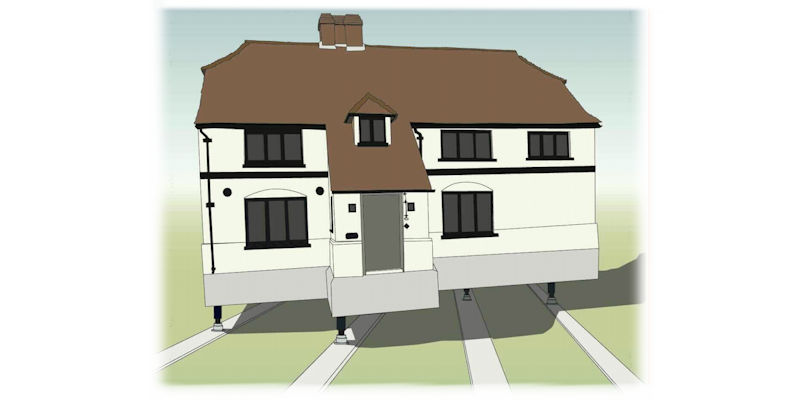
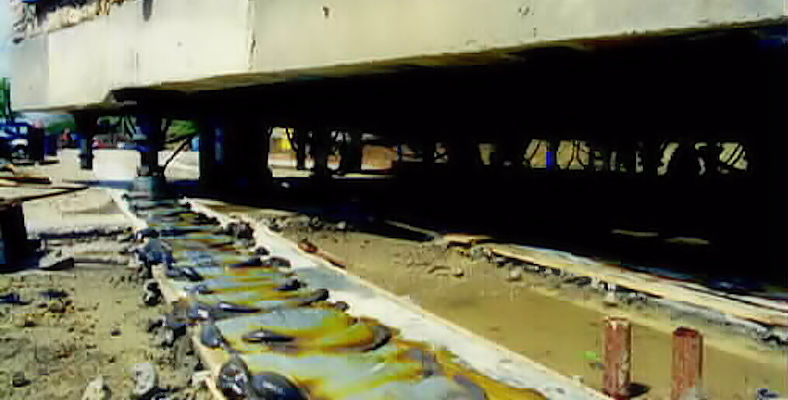
The Channel Tunnel Rail Link collection details the historic investigations carried out prior to the construction of the rail link between St Pancras Station in London and the Channel Tunnel. The construction gave archaeologists an excellent opportunity to investigate the human activity on a large swathe of land. The whole project was divided into 28 main sites, which produced a great amount of archaeological data. In order to carry out the investigations and preserve the historic environment some unusual activities were carried out, as depicted in this exhibit. Having moved the historic house using a slide technique, a 14th Century settlement was revealed underneath.
The Channel Tunnel Rail Link collection is one of the largest collections held in the ADS archive, with over 10,000 files, deposited in two phases in 2002 and 2008. This approach was intended to preserve as much data as possible from the initial site specific fieldwork (Phase 1), and the production of post-excavation assessments, through to the creation of scheme-wide appraisals, specialist reports and summaries added when completed (Phase 2). This methodology allows users to track the development of ideas and arguments through the whole fieldwork process; from the initial planning phase and the development of an appropriate research strategy, through the initial evaluation of discoveries following the fieldwork phase, and then on to production of specialist assessments and scheme-wide overviews of the entire project. Each phase of fieldwork produced datasets (spreadsheets, databases, drawings, geophysical, GIS and photographs) which are summarised in a series of 'site' and, more detailed, 'integrated' reporting which provide contextualisation for the data. More focussed specialist reporting and assessment of the ceramics, lithics, small finds, dating, human remains and palaeoenvironmental evidence was produced for many sites, these are then summarised in a series of 'scheme-wide' reports. Each of these reports is accompanied by datasets (databases and spreadsheets) which allows users to track specific information about those discoveries summarised in the 'specialist' and 'scheme-wide' reporting. Much of the information within the archive is summarised in the project overview, which allows the user to trace the development of the project, alongside summaries of the discoveries, through associated reports, images, drawings and databases.