
Introduction
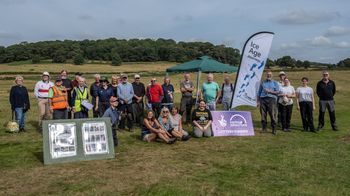
This collection comprises reports, images and spreadsheet data from fieldwork undertaken at Bradgate Park Lawns in September 2021 for the charity Ice Age Insights. The digital archive consists of supplementary notes on the geology and sediments by D. Garton, C. Baker, L. Cooper and R. Tyndall, a full pottery report by D. Budge, test pit location data and site photographs.
A field survey was conducted on the Lawns in Bradgate Park, in September 2021, as a component of a National Lottery Heritage Fund-funded collaborative project linking three Late Upper Palaeolithic sites in the East Midlands: at Farndon Fields, Bradgate Park and Creswell Crags. The survey was led by Lynden Cooper and Daryl Garton for the charity Ice Age Insights (charity number 1169575). The survey area is mapped by the British Geological Survey as a river terrace situated between the eastern mouth of Little Matlock Gorge, the site of a Late Upper Palaeolithic (LUP) Creswellian campsite, and a diorite outcrop to the immediate south of Bradgate House (a known LUP findspot), on the northern side of the present course of the River Lin. The Late Upper Palaeolithic site was excavationed in 2015-16 to mitigate the effects of erosion by visitor traffic; preliminary assessments are published by Cooper (2004; 2012). It is a very rare example of an open-air site with clear evidence for hunting, tool maintenance and animal product processing.
The 2021 survey aimed to model the superficial deposits on the floodplain, assess the potential for Late Upper Palaeolithic activity, and build a new skillset within the pool of volunteers who regularly contribute to other roles in the Park. Eighteen test pits at 20m intervals, with three additional test pits in areas of specific interest, were excavated, all 0.5x0.5m to 0.5m depth. 14 struck flints and an unworked burnt flint were recovered from eight test pits. All lithics are prehistoric (reported on by Lynden Cooper). There are no distinct chrono-types to enable closer dating, though none of the pieces would have been out of place when compared to the lithic technology of the nearby LUP site.
Three test pits produced five pot sherds (reported on by David Budge). A Raeren-type stoneware sherd (late fifteenth to sixteenth century AD) came from above a probable stone-drain. Three sherds are in fabrics considered to belong to the transition from Iron Age to Romano-British potting traditions in Leicestershire (second half of the first century AD and possibly into the first few decades of the second century). One body sherd may be of early to middle Anglo-Saxon date, though an Iron Age date cannot be excluded.
It is likely that the flint finds had been deposited originally on the surface of the head deposit and that they have worked down profile through geological and biological processes, a situation recognised at the Little Matlock Gorge LUP site where artefacts were found throughout the excavated head deposit. The recovery of Romano-British sherds, from test pits some 60m apart, complement the recent discoveries of other Roman artefacts on Bradgate Park Lawns, strongly hinting at some Romano-British settlement on the Lawns.
This fieldwork is published in the Transactions of the Leicestershire Archaeological and Historical Society vol 96 for 2022. The artefacts and site records are deposited with Leicestershire Museums XA78.2021.
Associated publications
- Cooper, L., 2002. 'A Creswellian campsite, Newtown Linford', Transactions of the Leicestershire Archaeological and Historical Society 76, 78-80.
- Cooper, L.P., 2012. 'An open-air Creswellian site at Bradgate Park, Newtown Linford, Leicestershire', Lithics: the Journal of the Lithic Studies Society 33, 30-39.
- Cooper, L. and Garton, D., 2022. Transactions of the Leicestershire Archaeological and Historical Society vol 96, 1-12.