
Introduction
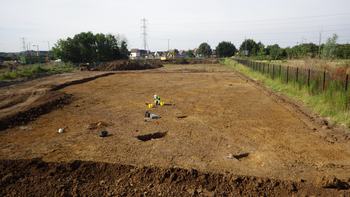
This digital archive contains site records, images, reports, GIS and an excel database on skeletal data from a series of investigations between 2007 and 2016, undertaken by Oxford Archaeology, at Aylesbury Berryfields. This comprised an excavation undertaken in 2007 and 2010-12 across the main areas of the MDA (AYLBER07 and AYLBER10), a watching brief in 2012/13, which monitored development work in the same area (also under code AYLBER10), an excavation in 2013 along the Western Link Road (again AYLBER10), an excavation at the District Centre site in 2014 (AYLBER14), and, most recently, excavation in 2016 west of Paradise Orchard strip, map and sample (SMS) excavation area (AYLBER16).
Archaeological investigations were conducted by Oxford Archaeology to the north-west of Aylesbury in Buckinghamshire between 2007 and 2016 prior to the construction of housing and related infrastructure within the Berryfields Major Development Area. The fieldwork recovered evidence for human activity spanning the early Neolithic to the post-medieval period, with significant elements relating to a middle Iron Age settlement and the agricultural hinterland of the nucleated Roman settlement of Fleet Marston situated on the major Roman road of Akeman Street. A pit dated to the early Neolithic period was one of the earliest features on the site.
Radiocarbon dating of hazelnut shells recovered from the feature shows it to be one of the earliest Neolithic features in the region. The feature fits the general pattern of intermittent occupation by people moving across the landscape, possibly following the course of the River Thame. An enclosure relates to limited occupation during the middle Bronze Age, while funerary activity of the same period is represented by two ring ditches, likely to be the remains of disturbed barrows.
A pit alignment, a form of territorial boundary, was established between the late Bronze Age and the middle Iron Age and was succeeded by a boundary ditch. This was in turn replaced by a trackway, probably in the late Iron Age, which survived into the initial decades of the Roman period before being abandoned. The middle Iron Age settlement was characterised by roundhouses, enclosures and four-poster structures. The settlement's economy was mixed, with both arable and pastoral farming practised, but the emphasis appears to have been on grazing and the rearing of livestock. Cattle, sheep and horses were the dominant species represented, the last recorded in sufficient quantity to suggest a specialist horse farming element, perhaps involving trading or ranching and exploiting the location of the site on an important routeway. No other evidence that certainly dated to the late Iron Age was discovered, and it seems that the Roman-period roadside settlement of Fleet Marston, or at least that part uncovered at Berryfields, was established with no late Iron Age predecessor soon after Akeman Street was laid out. An extensive system of fields and enclosures was set out along the road and extending back from it. While a small number of military-related objects was found, the presence of a Roman fortress at Fleet Marston could not be corroborated, and it is likely that the objects post-date the invasion period and relate to the movement of soldiers along Akeman Street in the Claudio-Neronian period. Two timber piles found at the junction of Akeman Street and the River Thame represent the remains of a Roman bridge that carried the road over the river.
The early Roman economy at Berryfields, like that of the middle Iron Age, was based mainly on livestock, with cattle, horses and sheep again well represented. Wheat was grown and so too were fodder crops. The site may have played a specialist role in the supply of horses to the army and the region, and the presence at Fleet Marston of a mutatio or changing-post is not implausible. An array of conjoined ditched plots or a so-called ladder settlement was established along a minor road during the 2nd century AD, if not before. Other minor roads were laid out, and over time, Fleet Marston found itself at the intersection of routeways that took travellers into the countryside and on to major towns. The 2nd century also saw deposition in a wetland area that formed a natural pond of sorts by the side of Akeman Street. This served as a waterhole, but it may also have seen some ritual deposition, with passers-by attracted by its watery, liminal character.
By the later 3rd century AD, a pit was cut into the pond, which by that time had dried up. The pit breached the underlying water table, providing a supply of water for a roadside malting and brewing complex comprising a stone-lined pit, connecting channel and an oven. Such activity joins other industrial activity from the site that is likely to have catered for traffic passing through Fleet Marston along Akeman Street. Woodworking and metalworking workshops were set up along the road to provide objects for trade, repairs and spare parts. A spread of coins across roadside fields speaks of the establishment of markets at this important crossroads. Pottery arrived via the road network from across southern Britain and beyond, and the presence of 12 briquetage and marine shells identify trade connections with coastal regions. When the malting and brewing activity ceased, the pit that was dug into the pond received a range of material, including coins, wooden tools, a basket, whole chickens' eggs, remnants of shoes,whole ceramic vessels, and exotic plant material, the organic material preserved in the pit's waterlogged environment. Some of this evidence is likely to represent ordinary waste, but from the quantity of coins and association with highly unusual objects, the eggs in particular, it is difficult to avoid the conclusion that the pit saw ritual deposition. The sacred nature of the pit and the marshy environment around it is strengthened by some of the objects from an amorphous soil layer, among them numerous coins, brooches, and a fragment of a Bronze Age socketed axe. Elsewhere in the late Roman period, activity at Berryfields was confined to farming near the ladder settlement.
Activity ceased by the late 4th century. No evidence was recovered for activity in the Anglo-Saxon period. Agricultural activity resumed in the medieval period, with extensive evidence for ridge-and-furrow cultivation identified, some of it aligned with the former Roman roads. A late medieval or post-medieval enclosure, probably an oxpen, was recorded. The recovery of a medieval ampulla may potentially be related to pilgrimage to the well of St Osyth, located by historical sources further along the road to Aylesbury.