
Introduction
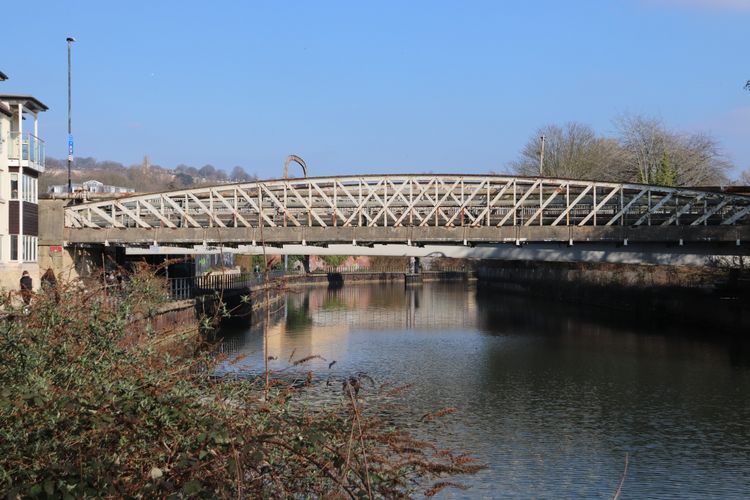
This collection comprises images and reports from Historic Building Recording work at Old Windsor Bridge/the Former Twerton Suspension Bridge undertaken by Bristol and Bath Heritage Consultancy Ltd between March and April 2023.
Following correspondence between Bristol & Bath Heritage Consultancy and Caroline Waldron, Senior Conservation Officer for Bath and North East Somerset Council in late September 2022, it was agreed the record should be primarily a detailed photographic record to supplement the already detailed information and analysis contained in the 2021 Heritage Statement by Bristol & Bath Heritage Consultancy Ltd. The photographic recording, when combined with the information and analysis already provided in the Heritage Statement, would result in a record equivalent to Level 3, as detailed in Understanding Historic Buildings: A Guide to Good Recording Practice (HE 2016). In March 2023 Bristol & Bath Heritage Consultancy undertook a historic building record of two iterations of an historic road bridge (old Windsor Bridge/former Twerton Suspension Bridge) which linked the Twerton and Weston areas of Bath from 1837 to 1980 at Windsor Bridge Road, Bath (centred at NGR: 373553, 165047). The bridge, which was repurposed to carry gas pipes in 1979, and subsequently telecommunication ducts, had become redundant in that function by the beginning of 2023 due to the rationalisation of the local gas network, and was in poor condition. Recording of the bridge was therefore required prior to its imminent substantial demolition, to make way for enhanced public realm as part of the Bath Western Riverside Phase 2 housing development.
The original Twerton Suspension Bridge was built by the Bristol civil engineer Thomas Motley in 1837, with the backing of Henry Stothert of the well-known Bath engineering firm Stothert and Pitt and other local figures, to provide a road crossing between Twerton on the south of the Avon and Weston to the north. Motley's bridge was built in competition with the 1836 Victoria Suspension Bridge, or 'Dredge's Bridge' some 550m along the Avon to the east, built by a local brewery owner in what became a notorious rivalry between Motley and Dredge, both locally and nationally. The Twerton Suspension Bridge was a remarkable anticipation of the cable-stay type bridge used more commonly in the modern era, the Second Severn Crossing/Prince of Wales Bridge being a prime example. In 1894 the suspension bridge was replaced by a bowstring girder bridge with lattice girder side spans, which were designed to rest on the pier bases of the earlier bridge and to use the 1837 approach ramps. It also carried a gas pipe from the nearby Gas Works across the river on its eastern side. By the early 1930s the bridge had become known as the Windsor Bridge. By the end of 1980 a New Windsor Road Bridge had replaced the old Windsor Bridge/former Twerton Suspension Bridge, which was then stopped up and converted into a service bridge carrying multiple gas pipes across the river. The pipes were still there in March 2023 but apparently now decommissioned.
The bridge abutment pier bases and western side of the northern approach ramp of the 1837 suspension bridge appeared to be all that survived of that bridge in March 2023, the southern approach ramp having been replaced by a reinforced-concrete structure, designed in 1942 and apparently completed by 1943 as part of a war-damage repair and strengthening programme. The pair of pier bases was identified as an unlisted building of merit and a building 'at risk' in the local authority's Conservation Area Character Area Appraisal for Brassmill Lane, Locksbrook and Western Riverside, although the Heritage Statement considered the surviving elements of the historic northern approach ramp should also have been included as part of the unlisted building of merit. The 1894 bowstring girder bridge survived, but was in poor condition, with severe corrosion of its metalwork and spalling of concrete. The 1894 bridge, designed by Handyside of Derbyshire and built by Lysaght Ltd of Bristol, was considered to be of lower historic and evidential interest than the suspension bridge that preceded it, and this had been extensively repaired and modified in the mid- to late-20th-century, firstly following war damage, and later to carry gas pipes.
All elements of the bridge were recorded photographically, and the photographic archive will be deposited with the Archaeology Data Service, from where it will become available online. The project report presents a selection of photographs from the recording project and a description and analysis of the bridge's history and development.