
Introduction
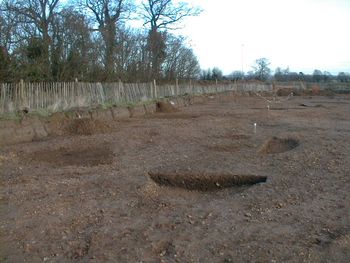
This collection comprises images, reports, GIS files and a database from the excavation of the medieval village of Stratton. The Stratton Project was prompted by the residential development of land on the south-east of Biggleswade, Bedfordshire. It comprised a multi-stage archaeological investigation undertaken by the Bedfordshire County Archaeology Service (BCAS), now Albion Archaeology, with the fieldwork element conducted between 1990 and 2001.
Plans for large-scale development on the south-eastern edge of Biggleswade, Bedfordshire, led to the planning of a major archaeological excavation to investigate and record the deserted medieval village of Stratton, which lay partly within the affected area.
Following evaluation in 1990, open-area excavation began in 1991, but it quickly became apparent that the medieval village was surrounded by the remains of its Anglo-Saxon precursor. Thus began a decade of excavations, exploring the village's development from its origins in the 5th century AD through to its demise in the 18th. The excavated area covered 12ha in total, exposing roughly half of the medieval village and representing one of the largest excavations of an Anglo-Saxon settlement to have taken place in England, certainly at the time.
The village had modest origins, situated on previously uninhabited land and occupied by perhaps no more than two or three families at a time in the 5th and 6th centuries. Its expansion began in the 7th century, when the imposition of an extensive field system suggests the influence of the Church, and a greater and more complex array of domestic structures can be identified. A new field system was set out in the middle Anglo-Saxon period, before a radical change in the settlement's layout was imposed in the 9th century. This occurred at roughly the same time as the Danelaw was established in this part of the country, although a direct causal link remains elusive.
Changes to the layout of the settlement continued to be made throughout the Middle Ages, but its overall form had largely crystallised by the 11th or 12th century under the influence of the two manors which held land in Stratton. The capital messuage of the main Stratton manor is preserved as a scheduled site to the south-east of the excavation area. Part of another moated site and the two dovecots that were revealed represent a direct link with the medieval manors, while a substantial, high-status timber building may have been associated with one of their late Anglo-Saxon precursors. The other medieval buildings - mostly timber, though a few had masonry foundations - would have been inhabited by tenants of the manors. Documentary sources suggest that the resident lords of the manors gradually began to reduce the number of tenants in the late 17th or early 18th century, remodelling the village into the classic estate landscape of Stratton Park.
The excavations revealed a settlement that was constantly in flux, when viewed from the perspective of its life over more than a millennium, but which in many ways remained remarkably constant over that period. Stratton was not a wealthy village, existing as a dependent township within the parish of Biggleswade, and the focus of the excavations lay primarily on the homes and activities of the ordinary villagers rather than the social elite. This publication chronicles 1,300 years of a small, low-status farming community - the crops they grew, the animals they reared, and the goods they traded or made themselves.