
Introduction
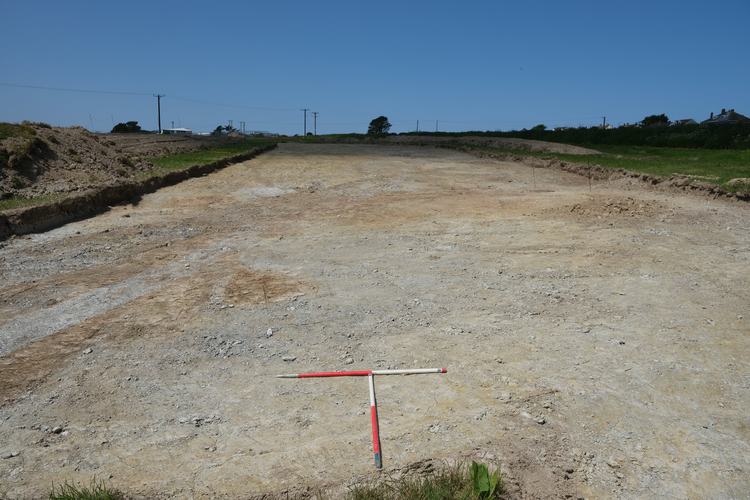
This digital archive comprises images, GIS and site record data from an archaeological evaluation & watching brief at Area 9c, Nansledan, Newquay. The works were undertaken between 23rd May 2023 till 2nd June 2023. The archaeological trial trenching evaluation and watching brief mitigation undertaken in accordance with agreed WSI. Adheres to CIfA guidance.
Watching Brief:
An archaeological watching brief was carried out by Museum of London Archaeology (MOLA) on groundworks for a small site 'Area 9C' within the wider Nansledan Development, Newquay. This report has been prepared by Jennifer Smith of Museum of London Archaeology (MOLA) for Landgage Heritage acting on behalf of the Duchy of Cornwall.
The aims of the watching brief were to monitor and preserve by record archaeological remains of interest revealed during the works, as well as to ensure the results are made publicly accessible in line with National Planning Policy.
A total area of 0.53ha was stripped to natural substrate and archaeologically monitored. Works included the footprint of a service line, together with an extra portion requested by the client on site.
Archaeological remains were encountered at the eastern end of the stripped area confirming the presence of three linear features that were identified from the geophysics data and some features that were not detected during the survey. These included two pits and three other linear features, all of unknown date. The presence of one, potentially Post Medieval field boundary was confirmed, along with a possible drainage ditch.
Evaluation:
An archaeological trial trenching evaluation was carried out by Museum of London Archaeology (MOLA) on land south of Henver Road and east of Trevenson Road, Nansledan, Newquay. The work was conducted in anticipation of proposed development at the site which, based on previous works, had potential to disturb archaeological remains, specifically of a Prehistoric, Romano-British and Medieval date. Prehistoric round barrows, Iron Age Cornish rounds (enclosed settlements) with continued occupation into the Romano-British period and Medieval Christian settlements have all been identified in the area. This report has been prepared by Jennifer Smith of Museum of London Archaeology (MOLA) for Landgage Heritage acting on behalf of the Duchy of Cornwall.
The objectives of the work were to determine the character, date, location and preservation of any archaeological remains on site with the view to understand the site and its significance, with a particular emphasis on the linear anomalies identified on the site from the geophysical survey.
A total of 8 evaluation trenches were excavated targeting the most prominent linear anomalies identified from the geophysics data. Archaeological remains were encountered in five trenches confirming the presence of several linear features that were identified from the geophysics data and some linear features that were not detected during the survey. The presence of three, potentially Medieval, field boundaries was confirmed, along with a drainage ditch. Two more drainage ditches, as well as an undated curvilinear feature and linear feature were also recorded.