
Introduction
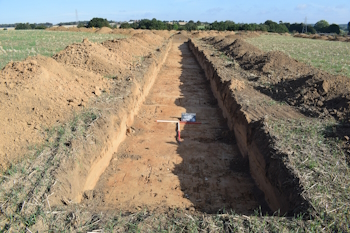
This collection includes site photographs, CAD data, spreadsheets, a database and site records from a programme of archaeological evaluation at Burstall Lane, Sproughton, Suffolk (TM 11864 45046) conducted by Oxford Archaeology East (OA East) between the 27th August and the 13th September 2019. A total of 76 trenches were excavated within a proposed development area of c.10.94ha of agricultural land three miles west of central Ipswich, on the western side of the Gipping valley.
Evidence for prehistoric activity was found in three areas. In the south-western part of the site, a previously recorded cropmark of a ring-ditch, with a diameter of c. 25m, was exposed in Trench 5, confirming the presence of this feature and exposing a fairly substantial ditch on both sides of the ring-ditch, although no finds were recovered. A second ditch was exposed on the western side of the ring-ditch - this may represent an outer ditch or associated feature, although it is also possible that it is associated with Iron Age activity in nearby Trench 75 as two sherds of Iron Age pottery came from its upper fill.
Evidence for Iron Age activity was also revealed in two other trenches. In the south-western part of the site (Trench 75), close to the ring-ditch, a pair of intercutting pits were found associated with a fairly substantial assemblage of Early Iron Age pottery and fired clay, whilst in the eastern part of the site (Trench 45) the corner of a probable enclosure ditch was revealed, which produced an assemblage of Middle Iron Age pottery.
Across the site, a series of undated ditches were exposed: these were mostly aligned broadly east-to west or north to south and are probably comparable to similarly aligned field systems known as cropmarks from the surrounding area. A small number of modern pits and boundary ditches were recorded in several trenches in the eastern part of the site.