
Introduction
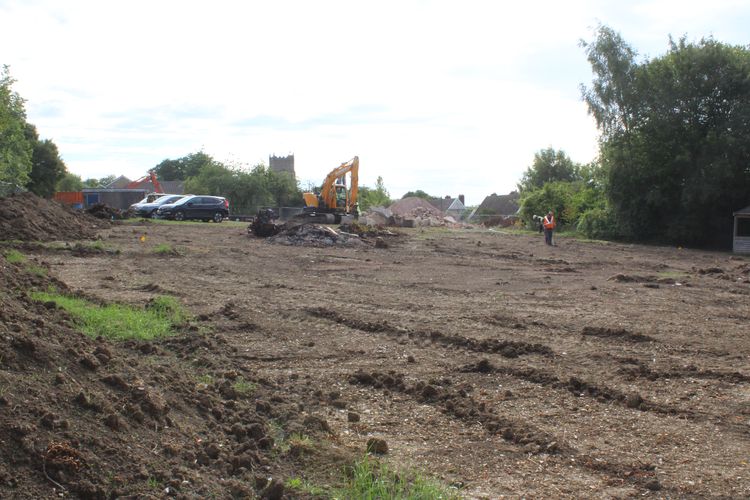
This collection comprises a report, images, and site records from an archaeological excavation carried out by Border Archaeology from August to October 2020 at Monks Eleigh Controlled School, Churchfield, Monks Eleigh, Babergh, Suffolk.
Border Archaeology undertook a programme of Archaeological Excavation on behalf of ACAP Associates between August and October 2020 at the Former Monks Eleigh Controlled School, Churchfield, Monks Eleigh, Babergh, Suffolk (NGR: TL 9639 4774). The works were carried out in connection with the redevelopment of the former school site for residential use, including the formation of a new vehicular access off Churchfield together with associated landscaping and related improvements (Planning Ref. B/16/01718/OUT).
The excavation revealed peripheral evidence for Romano-British settlement activity likely relating to the presumed high-status structure, potentially a villa, identified to the E of the Site in the 1940s. The ceramic evidence indicated that activity within the Site occurred during the Late Iron Age and mid-to-late 1st/ early 2nd Centuries, although it was of little help in assigning a dated sequence to the phasing for the Site. Artefactual evidence included a fragment of tesserae and pieces of hypocaust, as well as other ceramic building material, and at least three examples of copper alloy tweezers. Concentrations of dumped oyster shell and faunal remains that imply a combination of higher-status food waste and a settlement with an established agrarian and trade economy were also recovered, while the palaeoenvironmental analysis indicated a mixed grassland environment that was mostly dry with damp and shaded ditches close to an area of human activity.
The earliest feature stratigraphically was represented by a curvilinear ditch in the South-West corner of the Site which was later renewed and augmented to form a small enclosed area that likely formed part of a wider boundary. There is evidence that during this phase or slightly after there was an inundation of colluvial material representative of water erosion or hill wash originating from the area North of the Site. These deposits contained similar residual local and imported ceramics, and partially sealed the terminal end of a large pit or ditch which extended beyond the West limits of the Site and which contained several distinct tips of domestic waste. A pair of East-West aligned ditches were likely established to help alleviate and mitigate this period of inundation.
Shortly after this phase of activity the Site appears to have been enclosed by a large curvilinear ditch, orientated roughly North North East-South South West, which extended across the East half of the Site. Internally there are two shorter and shallower ditches which follow the same orientation and which partly truncated the earlier colluvial deposits, possibly indicating the need for continued drainage or land management. The enclosure ditch appears to have been renewed by a second ditch excavated along its West edge which terminated within the excavation area, and to the North of which was a corresponding ditch terminus forming a continuation of the enclosure which may have been arranged to form an entrance.
Whilst no structural remains were encountered, the formation of ditches and pits as well as the artefactual and faunal remains uncovered during the excavation suggests that the area remained peripheral to a domestic settlement. There is no further evidence for activity after the beginning of the 2nd Century, and it is likely that the focus of settlement shifted or fell into decline during this period.