
Introduction
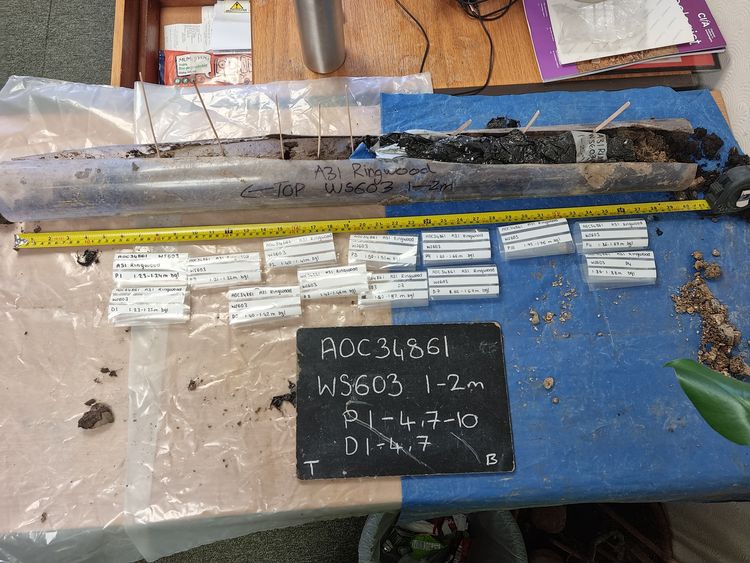
This collection comprises images, reports, and spreadsheets from a geoarchaeological borehole evaluation and the subsequent palaeoenvironmental assessment at the site of Jubilee Gardens, Hampshire, as part of the A31 Ringwood Improvement Scheme (NGR 414343 105245), carried out in March 2022. The work was undertaken by AOC Archaeology Group for Volker Fitzpatrick and Stantec on behalf of their client, National Highways, as part of the wider scheme archaeological mitigation package agreed with Hampshire County Council.
The geoarchaeological evaluation comprised the drilling of 2 purposive geoarchaeological boreholes to a maximum depth of c. 5m bgl, and the extraction and retention of the cored samples. Together with local geotechnical records, these were used to produce deposit models. Geoarchaeological and geotechnical deposit data can be used to identify areas of archaeological potential by characterising the probable nature and depth of sub-surface deposits. These have been refined following the results of the palaeoenvironmental assessment (including those of pollen, diatoms, ostracods, macroplant remains, and radiocarbon dates obtained from the Holocene sequence), with updated models presented within the reports in this archive.
The deposit sequence recorded across the site included Tertiary Bedrock of Selsey Sand and Barton Sand, Pleistocene River Terrace Gravels, Holocene alluvium and organic deposits, made ground, and topsoil. Six subsamples were taken from the Holocene alluvium and organics sequence sampled (AOC34537_WS603) for each pollen, diatom, and ostracod assessment. Two additional bulk samples were acquired for macroplant assessment, and for radiocarbon dating. The assessment has identified which proxies may be useful for a further stage of analysis.
Development impacts from the currently proposed A31 westbound carriageway expansion, and junction and bridge improvements may affect peat deposits which may be preserved in situ, as well as the Holocene alluvial sequence which has been shown to begin approximately during the early to mid Neolithic period. It is recommended that the impact on deposits of interest may be mitigated by palaeoenvironmental analysis of pollen and diatoms, the assessment of which has suggested these to be of interest combined with radiocarbon dates. Ostracods were not preserved well within this sequence, and macroplant assessment showed the assemblage to be small in number and unlikely to aid in answering specific research questions.
Associated Publication
Taylor, J., Langdon, C.T., Scaife, R. and Cameron, N.G. 2025 The River That Swallowed the Ringwood Prehistoric Landscape: Geoarchaeological Investigations in Advance of the Development of the A31, Hampshire, England, Internet Archaeology 69. https://doi.org/10.11141/ia.69.6