
Introduction
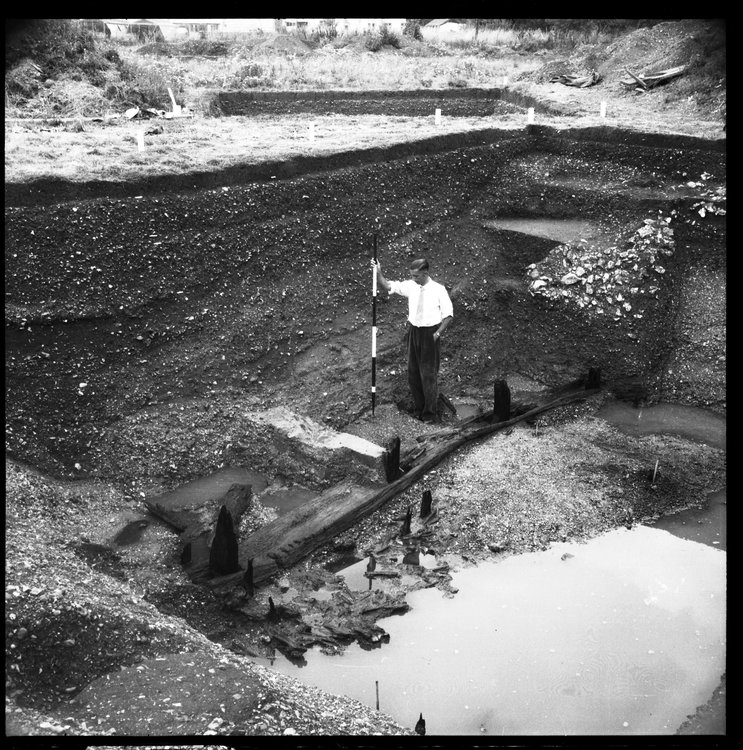
This collection comprises image, text and spreadsheet data from the Unlocking Old Windsor project which made an assessment of Brian Hope-Taylor's 1953-58 excavation archive from Kingsbury, Old Windsor, Berkshire.
Between 1953 and 1958 the late Brian Hope-Taylor undertook six seasons of excavation at Old Windsor, Berkshire. His discovery of a remarkable sequence of Saxon and Early Norman remains from the 7th to 11th-centuries, reported at the time as including a Mid-Saxon settlement, a 9th-century mill leat and watermill, and a series of high-quality buildings and finds indicative of a Late Saxon and Early Norman royal complex, cemented his position, along with his much-lauded excavations at Yeavering, as one of Britain's most influential archaeologists of the 1950s and 1960s.
His interpretation of the site, in part influenced by documentary sources, as the royal pre-cursor to New Windsor, has secured the position of Old Windsor as one of the most important sites of the period in southern England even though Hope-Taylor's records have never been subject to any detailed scrutiny, analysis or publication. The major barrier to such research has been the historic division of the Old Windsor archive between Historic Environment Scotland in Edinburgh and Reading Museum which has been a serious impediment to sharing and understanding the results of his work. There has long been a call amongst archaeologists to remedy this highly unsatisfactory position and hence the Unlocking Old Windsor project was conceived.
Over 20 years after his death and over 70 years since his excavations began, the Unlocking Old Windsor Project, funded by Historic England and undertaken as a collaboration between the University of Reading and Berkshire Archaeological Society, was created to take a substantial step forward to rehabilitate Hope-Taylor's excavations and to realise its potential as a site of national importance, the site having been designated as a Scheduled Monument (No. 1006995) in 1955.
The project set out to consolidate, secure and digitally unify the archive and to analyse a key sample of the records to generate, for the first time, an informed archaeological narrative of the site and a robust evaluation of its potential for future research.
As a result of the project, all of Hope-Taylor's excavation records held by Historic Environment Scotland (HES) in Edinburgh have been digitised and made publicly accessible via Historic Environment Scotland’s Old Windsor Archive Collection. Key excavation and post-excavation records held by Reading Museum are deposited here with the Archaeology Data Service so that the barriers of a split archive are overcome. Additional Ancient Monuments Laboratory Reports are available via Historic England.
The Reading Museum documents submitted here include:
- A summary of the 1950s site recording conventions and a 'context index' created by Hope-Taylor in the early 1980s, both documents providing a critical bridge between the excavation records in Edinburgh and the largely post-excavation and finds archive in Reading Museum
- Several finds' reports prepared in the 1980s and those prepared specifically for this project, including an assessment of the preserved wood from the Saxon mill and pottery spot dating and assessment.
- A selection of black and white photographic images from the 1950s excavation derived from the black and white negative film archive held by Reading Museum. The selection excludes duplicate and poor-quality images. Reading Museum holds the digitised images of the whole photographic archive.
A key part of the project was an assessment of the archaeology in three of Hope-Taylor's excavation trenches:
- GD1/2 - the main excavation across the Great Ditch, a mill leat, which included the remains of a mid-Saxon mill
- ID/X - one of the two excavation areas inside the Great Ditch and in Hope-Taylor's 'Palace Area', where a sequence of large Saxon timber halls were investigated
- OD3 - one of several trenches investigating the area of later Saxon/early Norman settlement outside of the Great Ditch
Archive material generated in 2023-24 relating to this assessment includes Excel spreadsheets covering context records, bulk finds, small finds and pottery spot-dating. The results of this assessment (Maričević, Smith and Thomas, 2024), and the preliminary archive assessment (Smith, 2019), are also deposited here with ADS. The former provides the first detailed account of a sample of Hope-Taylor's excavations at Old Windsor. The project authors now hope that the digitised Old Windsor records, now available through HES and ADS, will provide the foundation, framework and inspiration for further research and analysis of Hope-Taylor's excavation of this nationally important Saxon and early Norman complex.