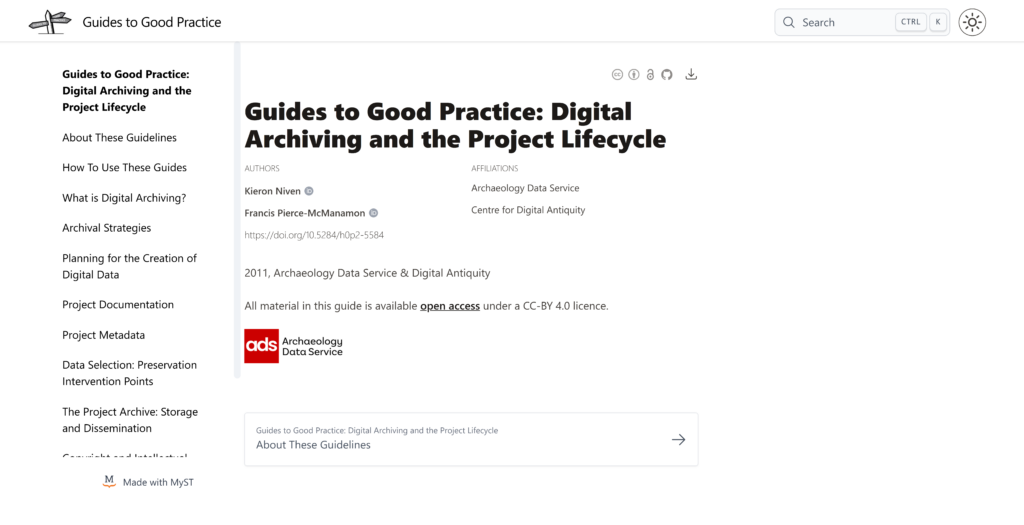
We are excited to announce the relaunch of our long-running Guides to Good Practice, now in a brand new format that represents a significant leap forward in making these digital resources more accessible and reusable.
The Guides to Good Practice provide comprehensive guidance for creating, managing, and preserving digital archaeological data across the entire project lifecycle. Developed by the ADS and partners since 1996, these guides address the needs of archaeological agencies, project creators, and data management professionals. Learn more about the Guides on the ADS website.
Why This Matters
Since 1996, the Archaeology Data Service (ADS) has been committed to preserving and disseminating archaeological data in accordance with FAIR data principles. This latest initiative takes this commitment to the next level by reimagining how we share critical digital archiving knowledge.
Groundbreaking Improvements
Each guide now features a persistent Digital Object Identifier (DOI) and a full citation format, ensuring proper attribution for those who utilise and cite these resources. We have also shared both the content and source code via GitHub, enabling others to suggest improvement, adapt and build upon these guides.
Each of the existing guides have also been migrated to a Jupyter Notebook format, which provides benefits to usability and accessibility.
Why Jupyter Book?
After evaluating various technologies, we selected Jupyter Book, drawing inspiration from collaborative platforms like The Turing Way.
This format offers multiple advantages for our users:
- Enhanced searchability using a search bar along the top of each guide
- Logical content organisation, navigable via side menus
- Readable presentation across all devices
- Ability to download pages for offline use
- Source material via Github that users can interact with and reuse
Looking ahead
As part of the Heritage Science Data Service, we are planning a series of new guides to expand our approach to new practitioners and data types. Our goal is to continually improve digital preservation practices across the heritage sector.
Interested in contributing or learning more? Keep an eye on our website and reach out to [email protected].