
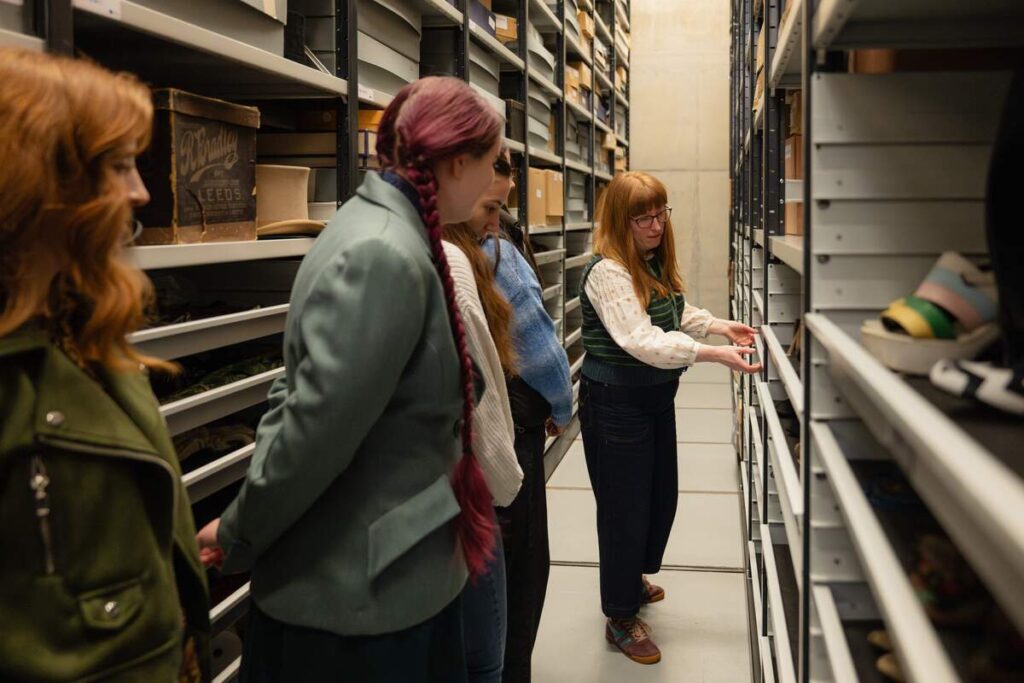
‘The book was thick and black and covered with dust.” This is the first description of archival material in A.S. Byatt’s Possession, a book that focuses on archival research as a main part of its plot. The retrieval is shrouded with death and funerary imagery described as being ‘exhumed’ from the vault after having been ‘laid to rest’. This stereotype surrounding archives and archival material is not limited to books, take for example the scene in the puzzle adventure game Professor Layton and the Lost Future where the titular hero visits the police archives. These archives are housed in a dark basement, and the professor’s apprentice, Luke, comments “Ew! These documents are all mildewy and covered in dust!” The presence of dirt and decay as an indication of the passage of time is more then evident. A lot of this is due the role archives often play in various types of media which has led to the common themes and motifs that built the archival stereotype.
The first frequent role of archives in popular culture is as a form of societal and organisational memory and history. Core to this is the common association of archival material with truth, in fiction once revealed very rarely is the validity of archival material questioned. In the film Paddington the true facts of a Paru expedition are hidden in the archives of the Geographer’s Guild and its validity is verified by the stories Paddington heard from his uncle and aunt. This association gives the fictional archival object both authority and authenticity.
As archival material is often the goal this leads to a second role archives play as obstacles. Multiple times the characters break into the archives, the trip to the Geographer’s Guild in Paddington being one of them. Other examples include George Smiley stealing a file from the Circus archives in Tinker Taylor Soldier Spy and in Benjamin Franklin Gates in National Treasure stealing the Declaration of Independence from the US National Archives.
As such archives are often depicted as closed off and restrictive places, with most of the characters depicted as permitted to enter archives being professors, doctors or at the very least educated to university level. People granted permission include Professor Layton from the Professor Layton series and Roland Michell and Maud Bailey from Possession, who both have doctorates, whereas Paddington and Mr Brown are refused entry in Paddington. Another example of archives as restrictive is the negative effect of the archives in The Blue Prince. In this puzzle adventure game players draft rooms to make their way through an ever changing house. When the archives are drafted one room from all subsequent drafts is hidden, hampering the players’ journey.
This a far cry from my experience at the Archaeological Data Service (ADS). The most obvious being we are a digital archive and therefore do not house paper documents and as such the rows of dusty files are impossible.
Then there is the closed and restrictive depiction of archives. While there are reason the ADS might place some restrictions on archives, to fulfil GDPR obligations for example, we do try to be as open as possible. Our released collections are available online to be accessed by any interested parties. A large portion of our archives not accessible to the public are made up of the backlog of those to be accessioned and processed for release. This backlog is an unfortunate and near ubiquitous aspect of the archival sector.
There is some validity to the depiction of archives as a form of memory, Appraisal has played an important role in all the archives I have worked at including the ADS. What is kept in the archive is ‘remembered’ able to be retrieved when required, and what is discarded is ‘forgotten’ and lost to time. The results reflect the opinions, priorities and unfortunately biases of the organisations and individuals that shape it into the future. This process is by not intentionally malicious; a key driving factor is that space, whether digital or physical is limited and not everything can be kept.
A lot of the stereotype discussed is born from assumed and actual lack of awareness within the general public related to archives and the work of archivists. A key indication of this is that libraries and archives are often depicted interchangeably, when they are not the same. Not all or even most archives are like the stereotype, and it would be great if general awareness of the variety of archives could be increased.