
Data Management and Digital Preservation shouldn’t be skills only some archaeologists can access. That’s why we’re opening our vault and providing access to our training materials. We are excited to announce the launch of the ADS Training Portal, which offers freely available Open Educational Resources for the ADS community and beyond.
The ADS has a long history of providing training in Data Management, Digital Preservation and Open Research to the archaeological community. Over the last three years we have increased our training provision and as such the number of training materials that we are producing. All resources archived with the ADS are Open Access, and delivered through our website to facilitate reuse by the heritage sector and wider community. As such, we created a new platform to offer our training materials in the same way via our new Training Portal. Every resource in the Training Portal will be published as an Open Educational Resource, which means you can use them, adapt them, and build on them for your own teaching and learning needs.
Open Educational Resources
UNESCO defines OERs as “learning, teaching and research materials in any format and medium . . . that have been released under an open license, permitting no-cost access, re-use, re-purposing, adaptation, and redistribution by others”. 
By adopting this approach the ADS will ensure that key training resources are freely accessible, fostering greater digital preservation and knowledge-sharing across the sector. This also ensures the ADS aligns with UNESCO’s Sustainable Development Goals (SDGs) – particularly in Quality Education (SDG 4), which ensures that our training materials are available for all to “Ensure inclusive and equitable quality education and promote lifelong learning opportunities”.
The Training Portal
To accommodate the diverse range of our training materials, we have developed a custom Training Portal, which is accessible via the Help and Guidance section of the ADS website. The Portal’s architecture was inspired by other successful training platforms such as DARIAH Campus, which has been created for arts and humanities researchers. Jamie Bradley, ADS Lead Software Developer, undertook the development of this new and innovative platform, tailored to meet the specific needs of the archaeological user community.
To ensure that these resources can be defined as OERs, each resource in the Training Portal includes:
- A description of resource, including how it could be used for future training
- A link to resource
- A list of Author(s) and Contributors
- A Persistent identifier (a DOI minted by the ADS)
- A full citation (to copy and cite the resource)
- An open licence attribution (in most cases Creative Commons CC BY 4.0).
- A table of metadata related to that resource
This approach ensures that our training resources not only meet accessibility standards but are properly documented and credited, and are trackable in terms of their impact and reuse via the DOI.
Some Initial Highlights
Several training resources have been prepared in this format and are now published, available for reuse with proper attribution with a citation.
The ADS Archiving Workflow
Nicky Garland, Katie Green, Olivia Foster, Jenny O’Brien (2025) The ADS Archiving Workflow http://www.doi.org/10.5284/8qes-6g82
This is a plain language introductory guide to the main steps of the digital archiving process as undertaken by the ADS, including both human-led and machine (i.e. automated) tasks. This workflow describes the general archiving process of a typical collection archived with the ADS. A detailed glossary is included that provides definitions of technical terms.
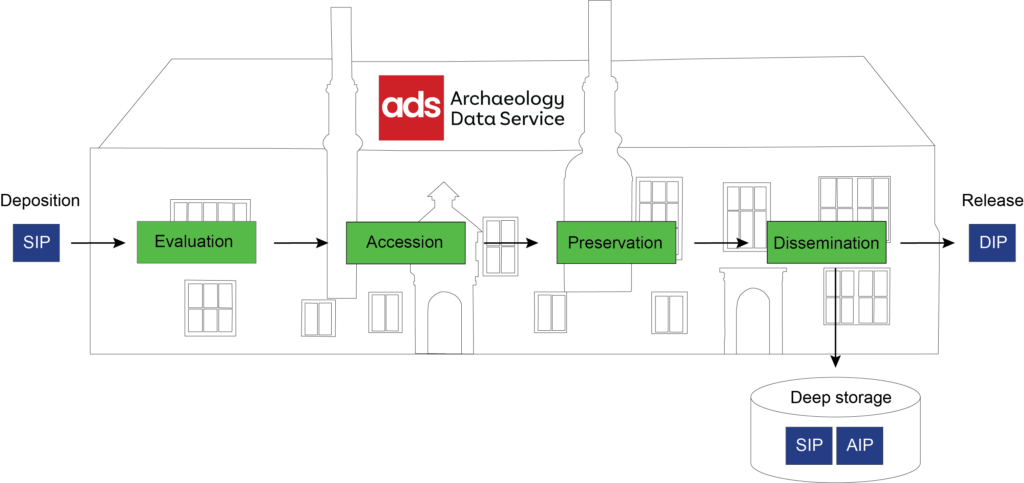
This document is a useful training resource for those new to or learning about digital preservation. This document also provides a useful case study of how the Open Archival Information System (OAIS) reference model is employed in practice, particularly in relation to heritage based collections.
Data Management for Archaeological Researchers
Nicky Garland (2026) Data Management for Archaeological Researchers. https://doi.org/10.5284/MZXZ-7H40
This resource is designed to address the unique challenges archaeologists face in data management, including specific archaeological case studies to demonstrate effective data management in practice. This online training manual provides an introduction to the necessary knowledge and skills to effectively manage data throughout the research life cycle. The course covers:
- good practice in data management
- open research practices
- effective and efficient planning
- documenting your data
- ensuring your data’s long term preservation
This resource will allow users to gain a comprehensive understanding of data management practices and learn how to apply them to their own research projects, including how to create a data management plan for their own research projects and research funding applications. This resource is focused specifically towards researchers in the discipline of archaeology but is equally applicable to all researchers across multiple heritage fields.
Coming Soon
We are actively seeking additional resources to expand the Portal both from staff members within the ADS and our key collaborators. We have pledged to add one new resource per quarter (every 3 months), which will be advertised via the ADS website and social media channels.
Some upcoming resources include instructional videos on metadata fundamentals for beginners and curated datasets suitable for undergraduate and graduate-level research projects.
The development of the Training Portal, as well as our recent migration of the popular Guide to Good Practice series to a Jupyter Notebook format, formed part of a case study developed as part of my participation in the Turing Way Practitioners Hub. This case study can be downloaded for free from Zenodo at the link below:
Garland, N., Niven, K., Evans, T., Gillespie, S., Sharan, M., Bennett, A., & Demertzi, L. (2025). Archaeology Data Service: Transforming the Accessibility and (Re-)Usability of Archaeological Training Resources. Zenodo. https://doi.org/10.5281/zenodo.15068950
Browse the full catalogue at the ADS Training Portal. All materials are freely available under open licenses—download, adapt, and use them in the way that best serves your needs.